Jiggers
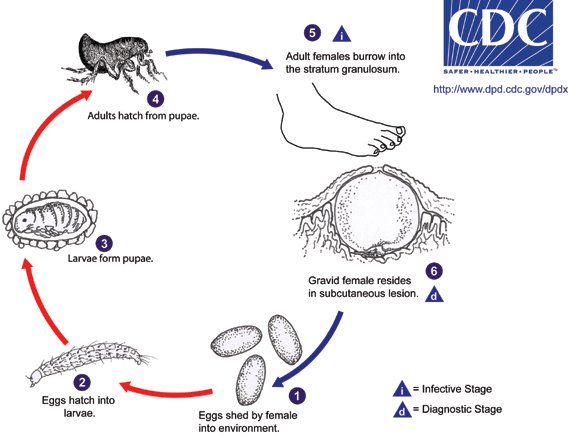
Jiggers are flesh-burrowing fleas. They are found in Central and South America, which is where they originally came from, and Africa, to which they spread in the 18th century via ships. 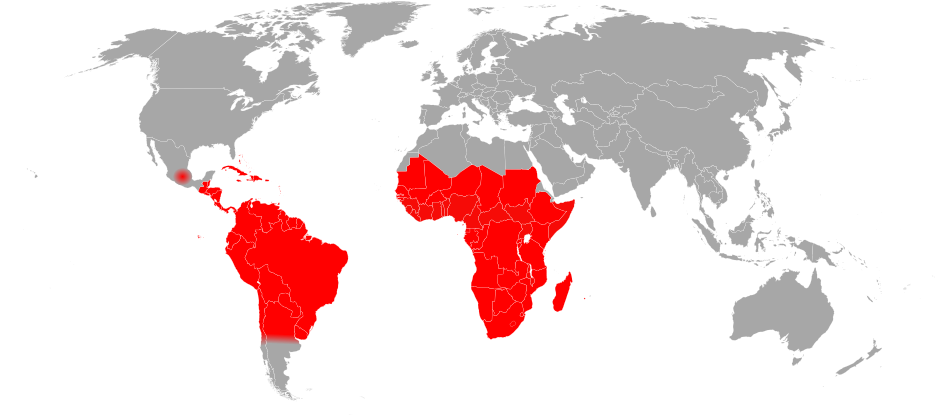 They live in dry sandy soil. At 1mm long, they are the world’s smallest fleas. The female jigger burrows under the skin of a human or animal host, typically under the skin of the foot. Once under the skin, within a few days it swells up to 1cm across as its body fills with eggs.
Jiggers are far more common in the dry season than in the wet season; this needs to be considered when running experimental trials.
Treatment
Section titled “Treatment”Surgical removal
Section titled “Surgical removal”Traditionally, jiggers have been removed surgically, although in the absence of suitably skilled medical care, jiggers must be left alone to be shed naturally because of the high risk of serious infection from less-than-skilled or non-sterile surgery. Great care is needed to avoid rupturing the insect during removal, otherwise severe inflammation can result. It is also thought that removal of jiggers using shared, non-sterile instruments may be contributing to the spread of hepatitis and HIV 1.
Skilled medical staff may nevertheless prefer to remove jiggers surgically because:
- the larger jiggers will shed eggs
- even when the jigger is left in place, the surrounding skin can sometimes become seriously (sometimes fatally) infected
Poisoning
Section titled “Poisoning”Jigfix
Section titled “Jigfix”Lynne Elson has had considerable success 2 in Kenya with Jigfix, a coconut oil / neem oil preparation. Jigfix is available from MWI Enterprises, Mombasa, Kenya. Phone +254 716 441560. Lynne says:
//They sell in 25ml bottles which we average 15-20 patients per bottle depending on the severity of infection and CHWs doing it. Drops directly on the jiggers and spread over the affected area since it also helps with bacteria and fungi, inflammation and healing. It spreads very easily, almost as well as NYDA. We treat a minimum of 2x, really severe cases 4x, once a day if possible or every other day.
I pay KSh 130 per bottle but I know that is a special price as I have been doing so much to support her. I’m not sure what her regular price is.“//
Benzyl Benzoate
Section titled “Benzyl Benzoate”Repeated applications of benzyl benzoate emulsion (BBE, a louse treatment) are sometimes used against jiggers. Advantages are low cost and simplicity of application but there is little about it in the literature. The WHO warns that “Benzyl benzoate should not be applied to acutely inflamed or broken skin”3 which is a potentially significant problem. A trial in Malawi4 based on just 6 subjects, only 2 of which were left by the end of the experiment, showed reasonably promising results, based on 3 applications per day plus an application of Vaseline to the feet at bedtime, over 7 days.
Suffocation
Section titled “Suffocation”The jigger’s airways can be blocked using petrolatum (Vaseline) or Nyda.
Petrolatum
Section titled “Petrolatum”Petrolatum (Vaseline) requires repeated applications; in particular it should be applied daily before going to bed. It is usually first applied after treating the foot with a disinfectant such as potassium permanganate solution (favoured by the Ahadi Kenya Trust). Vaseline is widely available in Ugandan households as it is used to moisturise the skin.
Nyda is a silicone oil blend that is approved in the EU and Canada for treating head lice. Although it has been used for medical research in Kenya it is not yet approved for regular use there or in Uganda. A single application of a drop or two of Nyda on the jigger’s protruding bottom (the black spot in the centre of the swelling) should be enough to kill it. Nyda fills the jigger’s airways by capillary action and blocks them so that the jigger suffocates.
Prevention
Section titled “Prevention”Sealing floors
Section titled “Sealing floors”Jigger infestations can be reduced by sealing floors, either with cement or a traditional African cow-dung floor, which provides a linoleum-like surface and for which a weekly or twice-monthly polish of cow dung is required.
Schools with unsealed floors are one of the ways that jiggers spread from household to household, so it’s particularly important to seal school floors.
The US and Rwanda-based charity EarthEnable is testing sealed floors to prevent jiggers. They produce an adobe (rammed earth) floor sealed with a soya oil varnish that has been polymerised using a commercially confidential process. The cost is around USD4 per square metre which is unfortunately too high for many people in rural Uganda without subsidy.
Many jigger programmes distribute shoes although research suggests that shoes are of secondary importance in preventing jiggers; a study in Madagascar 5 found that “only a marginal decrease in the intensity of infestation and in the attack rate was observed” in a group that was supplied with shoes. Toms will donate shoes if Whisper can distribute 10,000 pairs every 6 months; they also provide 25 US cents per pair towards distribution costs and the shoes they supply are normally bought from a manufacturer in the country where they are distributed.
Repellents
Section titled “Repellents”A repellent Zanzarin, based on coconut oil and essential oils, was field tested with great success but since 2013 the EU’s Biocidal Products Regulation has mandated formal toxicity testing for all substances that are marketed as repellants, so it is no longer manufactured. Zanzarin’s ingredients list, in descending order of quantity, is available online
Aqua, Capric acid, Cocos nucifera, Potassium stearate, Aloe barbadensis, Jojoba esters, Ceteareth-12, Ceteareth-20, Parfum, Panthenol, Tocopheryl acetate, Methylparaben, Propylparaben, Tromethamine, Citronellol, Geraniol, Hydroxycitronellal, Limonene, Linalool, Hydroxyisohexyl-3-cyclohexene carboxaldehyde, Alpha-isomethyl ionone
Insect growth regulators
Section titled “Insect growth regulators”Insect growth regulators (IGRs) might be another way to combat jiggers although we’re not aware of any trials. They have a hormonal action on the larval stages of the insect, preventing them from becoming adults. They are considered relatively safe and their action is specific to a particular insect; they are often used to prevent fleas indoors in developed countries. They could be mixed in a watering can and watered onto the floor of a house or other building. Here’s an example retailing at USD 10 that would treat around 10 rural Ugandan dwellings. Wholesale quantities should be much cheaper. A disadvantage is that the effect isn’t permanent; it’s only active for 7 months.
IGRs might be suitable for treating animal barns.
Nematodes
Section titled “Nematodes”Nematodes that specialise in killing flea larvae can be spread over infested land using a watering can. It might be possible to use them against jiggers although we’re not aware of any trials. Here’s an example of nematodes being sold for use in gardens: 6 Nematodes don’t travel very well so they may be best grown locally.
People and Organisations
Section titled “People and Organisations”The following people and organisations are working to combat jiggers.
Europe
Section titled “Europe”Prof. Dr. Hermann Feldmeier and his team of researchers in Berlin are world authorities on jiggers.
Uganda
Section titled “Uganda”Dr George Mukone is in charge of tungiasis programmes in the Ugandan Ministry of Health.
Sole Hope is a US-based 501c3 charity. In Uganda they are based in Jinja. In the US they have a lot of support from churches and they hold shoe-cutting parties, at which people cut shoe parts from sheets of material. They export the shoe parts to Uganda where they are stitched into shoes and distributed. For jigger treatment they pay third party clinics for surgical removal. From their own reports and filings, in 2017 they treated around 7000 cases and their total expenses were USD520K, so they treated one case for every USD74 that they spent.
Dabaso Community Unit uses the Jigfix coconut oil / neem oil mix to treat jiggers under the direction of Lynne Elson.
Ahadi Kenya Trust is a Kenyan charity. Ahadi’s founder Dr Stanley Kamau wrote a book A Jiggered Mind about the organisation’s history. When he started in 2007, he faced considerable opposition from local politicians who felt threatened by an independent NGO that was promoting welfare. His work only became accepted after he treated jiggers near the home of a former Kenyan president who asked his family to come out to help.
Kill the Jigger is an initiative of Rise Up Society, a Kenyan charity run by Jim Nduruchi.
Rwanda
Section titled “Rwanda”Anti Jigger Act (Facebook page here) was a small campaign in Rwanda run by Petra Teslerová.
Footnotes
Section titled “Footnotes”-
Jiggers Linked to Spread of HIV, New Vision, 27 Dec 2013, http://www.newvision.co.ug/news/650882-jiggers-linked-to-spread-of-hiv.html ↩
-
Elson et al, Control of Tungiasis in Absence of a Roadmap, Tropical Medicine and Infectious Disease, Volume 2 Issue 3, 2017 https://www.mdpi.com/2414-6366/2/3/33/htm ↩
-
Mitchell and Stephany, Infestation of Tunga penetrans in villages near Zomba Central Hospital, Malawi Med J v.25(3); 2013 Sep http://www.ncbi.nlm.nih.gov/pmc/articles/PMC3859996/ ↩
-
Thielecke M et al. (2013) Prevention of Tungiasis and Tungiasis-Associated Morbidity Using the Plant-Based Repellent Zanzarin: A Randomized, Controlled Field Study in Rural Madagascar. Plos Neglected Tropical Diseases https://doi.org/10.1371/journal.pntd.0002426 ↩
-
http://gardeningzone.com/products/nematodes-steinernema-carpocapsae-for-flea-tick-control ↩